A uniquely American solution to supplying a wartime Army
They weren’t the best. But they were good enough — and they were everywhere. Like the Sherman tank and B-24 bomber, the K-ration solved a WWII problem the American way: make it simple, make it interchangeable, and mass-produce it in staggering numbers.
Like the Sherman tank and the B-24 bomber, the K-ration solved a World War II problem in a uniquely American way: design something simple, good enough to get the job done, give it interchangeable parts, and mass-produce it in staggering quantities. This approach gave the Allies the overwhelming industrial power that helped win the war.
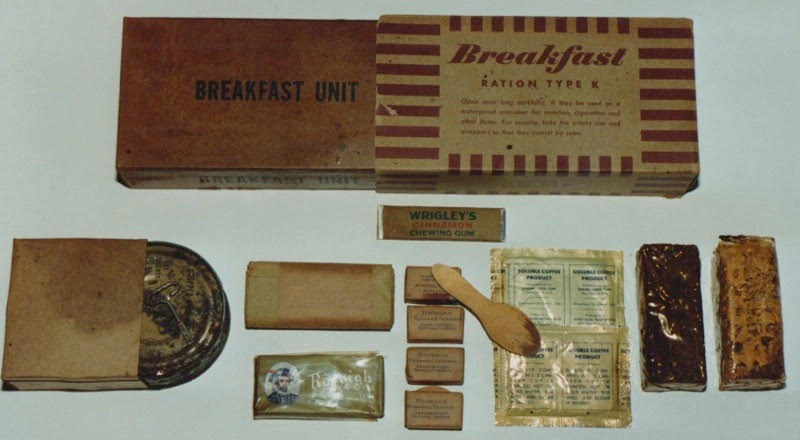
Inside The K-Ration:
Each waxed cardboard K-ration box held a breakfast, or a lunch, or a dinner: one of several kinds of canned meat or eggs with potatoes or beans or noodles, dry biscuits, a drink powder or instant coffee, a candy bar or a pressed fruit bar, four cigarettes, matches, chewing gum, sugar and salt, and toilet paper. A K-ration fit perfectly in the pocket of the M1 Field Jacket. You could heat water for coffee by burning the box. The Army could – and did – deliver them by parachute when necessary. Over 100 million factory-sealed K-rations were shipped around the world during the war, sustaining millions of our troops, allied troops, and even civilians during harrowing times.
The German Approach:
Germany, by contrast, chased superiority over scale. Its Tiger tanks, Me 262 jet fighters, and V-2 rockets were cutting-edge but complex, expensive, prone to failure, and not available in sufficient quantity. Even combat rations were custom jobs — most German troops relied on horse-drawn field kitchens, known as Wurstkanones (“sausage cannons”), for hot meals. But by 1944, hungry German troops were halting counterattacks just to eat captured K-rations.
Superiority impresses. Scale wins wars.